Kobzos Kiss Tamás - Erdal Şalikoğlu: Szívetekben őrizzetek
DOSTLAR BENİ HATIRLASIN
ER-CD 047

Âşık Veysel
Veysel Satiroglu - in Turkey better-known as Asik Veysel - was born in the Anatolian village of Sivriala in 1894. His peasant parents already – before his birth – lost two daughters because of the smallpox epidemic. At the age of 7 he got the virus and had gone blind. From this time onward his life was full of misery. His only consolation was the ‘saz’ (a long-necked lute, traditional instrument of the musician-poets) which he got from his father who liked the Bektasi dervish songs, and who often visited the tekke (the place where Alevians held their service). Asiks and Ozans – wanderer musicians - were frequent visitors in their house.
Veysel took his first lessons from his father’s friend called Asik Ala who told him about the great Yunus Emre, Pir Sultan Abdal, Karacaoğlan, Dertli and the others. His first famous poem was about Kemal Atatürk and it was written in 1933. (that year was the 10th anniversary of the announcement of the republic.) He wanted to show it to the ‘saviour of Turkey’ as he called Atatürk, so he set up with his friend and went to Ankara on foot. The meeting didn’t take place but his poem was published.
With his devoted companion Kücük Veysel – who also helped him in singing – wandered tirelessly in the Anatolian villages. His self-written songs were known and liked by many. Through such a journey in 1956 he was introduced to Alain Gheerbrant – the excellent French ethnographer- with whom he made local recordings in 1985. These recordings were published in Paris by OCORA.
My attraction to him was drawn by this publication which reflected his humanity and artistic grandee. The encounter with him was brought into existence by Sabahattin Eyüboğlu who was the tireless organizer of the Turkish literature and wrote about Asik Veysel: “This man educated himself with great patience and suffering. He represents ancestral traditions in his poetical world and instrumental play. Perhaps he is the last authentic figure of the musician-poetry, lute poetry. He was conscious about his age and kept an eye on the events of Turkey and the world. He created a new poetry accompanied by the ancient saz. His thoughts - risen from a world that sank into obscurity – can be a help in finding solutions to problems of modern man.”
Asik Veysel died in 21st March 1973. His birthplace is now a museum. CD-s and tapes of his songs sell really well, recently the Kalan Müzik Yapum Ltd. broadcasted a wide selection of his songs.
Tamás Kobzos Kiss
The saz
The saz is the most popular Turkish folk instrument. Its name means ‘instrument.’ The word “bahlama” is also used which means ‘to knot’. (that is because of frets are knotted on the neck of the instrument.) Once it was called kopuz and is being made in different sizes. On our album three different length saz appears. The tuning can be varied according to style and pitch.
Tamás Kobzos Kiss
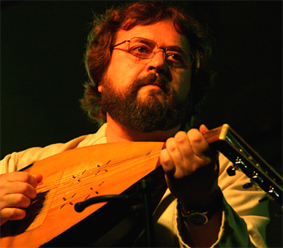
He was born in Debrecen in 1950. In the past 30 years he has given many concerts in different countries as a soloist or as a member of folk bands. His repertoire includes Hungarian folk songs and European historical music. Usually accompanies himself with koboz, lute, guitar, hurdy-gurdy and saz. He has more than 30 CD-s and tapes released both in Hungary and abroad. Since 1986 he is the teacher of and since 1991 the headmaster of the Hungarian Folk Music School in Óbuda. He is really interested in musical-poetry therefore he is untiring in his efforts to study the rich sang-poetry of Turkey. In his works he got great help from Erdal Salikoglu, with whom he has been working for 10 years now.
Erdal Şalikoğlu
He was born in Artvin (North-East Turkey) in 1955. At the age of 11 he moved to Istanbul with his parents. He got his first saz when he was 15. He studied at Bosporus University where – as a member of the internationally known dance group – became familiar with the ancient Anatolian dances and music. After a year he continued his studies for his doctorate at Istanbul University. (At present he works as a doctor in Istanbul.) During the university years he carried on dealing with folk dance and folk music. After the university he went to Anatolia and got in contact with village musicians and dancers and the Alevian-Bektasi music poetry. Later moved back to Istanbul and became the disciple of Yavuz Top. In May, 1991 he was on a further educational training in Budapest when met Tamás Kiss Kobzos. Since then they gave several concerts in Hungary, Turkey and on the Ancient-Music Festival of Csíkszereda, Romania.